
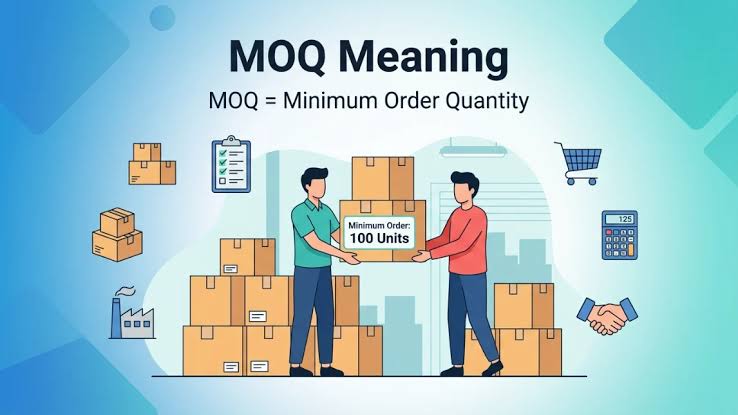
One of the first questions European buyers usually ask a Chinese supplier is:
“What is your MOQ?”
MOQ means Minimum Order Quantity. It can be 500 pieces, 2,000 pieces, 10,000 pieces or even more.
For a buyer who is new to sourcing from China, a high MOQ can be a problem.
But there is another side to the question.
Is a lower MOQ actually better?
Not necessarily.
If you already have a good sales forecast, ordering a small quantity just to keep the MOQ low can sometimes make your products more expensive to import.
This is why, when we work on sourcing projects, we don’t look at MOQ on its own. We also look at the factory price, packaging, container capacity and shipping cost.
Why Do Chinese Factories Have MOQs?
There is usually a practical reason.
A factory may need to buy raw materials, prepare a production line or order packaging before it can start manufacturing.
For a small order, these costs are spread over fewer products.
Take a simple example.
A factory may be able to produce 1,000 pieces for you, but the production setup takes almost the same amount of time as for 5,000 pieces.
The factory therefore has little reason to offer the same unit price for both quantities.
The same applies to customised products.
If you want your own colour, logo, mould or packaging, the supplier may need to make a separate investment. This usually pushes the MOQ up.
So when a supplier gives you a high MOQ, it’s worth asking why.
Sometimes there is more flexibility than the first quotation suggests.
A Lower MOQ Can Come With a Higher Price
This is easy to overlook.
Imagine a supplier gives you two prices:
1,000 pieces at €5.50
5,000 pieces at €4.20
The smaller order requires less cash and creates less stock.
But you are paying €1.30 more for every piece.
If you are planning to sell 5,000 pieces anyway, the lower MOQ doesn’t really help you.
It simply makes each product more expensive.
And then there is the cost of getting those products from China to Europe.
That’s where the calculation becomes more interesting.
Don’t Look at MOQ Without Looking at Shipping
A small order doesn’t necessarily mean a small shipping bill.
Let’s say you only order enough products to meet a low MOQ. Your goods may not fill a container, so you may need to ship them as LCL — Less than Container Load.
LCL is useful and sometimes the right solution.
But when you have enough demand for a larger order, it can be worth comparing it with a full-container shipment.
With FCL, or Full Container Load, your goods occupy the container.
Depending on the product, packaging and shipping route, this can reduce the transport cost per unit.
This is why we often look at 20GP and 40HQ container quantities when preparing a sourcing project.
The question becomes less about:
“How can we order as little as possible?”
and more about:
“What quantity gives us the best overall cost?”
Sometimes a Full Container Makes More Sense
Let’s say your supplier’s MOQ is 2,000 pieces.
You could order exactly 2,000.
But if those 2,000 pieces only occupy part of a container, it is worth checking what happens if you order more.
Perhaps a 20GP can hold 6,000 pieces.
Perhaps a 40HQ can hold 12,000.
The actual figures depend on the product and packaging, of course.
If your sales forecast supports the additional quantity, the larger order may give you:
- A better unit price
- Better use of the container
- Lower freight cost per piece
- Fewer shipments
- Simpler logistics
The result can be a lower total cost, even though you are spending more on the initial order.
But Filling a Container Is Not the Goal
This point is important.
We don’t recommend ordering 10,000 pieces simply because they fit in a 40HQ.
If you only expect to sell 3,000, the remaining 7,000 pieces are not a saving.
They are inventory.
And inventory has a cost too.
For a new product, a smaller first order may be the safer choice.
For an established product with regular demand, a full-container order can be much more attractive.
The right quantity depends on the business.
What If the Factory’s MOQ Is Too High?
This happens quite often.
You may need 3,000 pieces, while the factory says its MOQ is 10,000.
Before moving on to another supplier, try to understand what is behind the number.
Is it the raw material?
The packaging?
A mould?
A specific colour?
Or simply the factory’s preferred production batch?
The answer matters.
For example, a factory may accept a smaller first order if you use standard packaging instead of custom packaging.
Another supplier may agree to a lower quantity but charge a higher unit price.
Sometimes two colours or product variations can also be combined, depending on how the factory organises production.
There are different ways to approach MOQ.
It depends on the product.
MOQ and Container Capacity Are Two Different Things
This is another common misunderstanding.
MOQ is about production.
Container capacity is about logistics.
A factory may have an MOQ of 2,000 pieces, but a 20GP may hold 6,000.
Or the factory may require 5,000 pieces while a 40HQ can hold 15,000.
Neither number tells you what quantity you should actually order.
That’s why we normally look at the whole picture:
MOQ → unit price → packaging → CBM → container loading → freight → landed cost
Only then can you really compare two sourcing options.
What Should You Ask the Supplier?
When requesting a quotation from a Chinese factory, asking for the MOQ is a good start.
But don’t stop there.
Ask for the price at different quantities and request the packaging details as well.
For example:
- MOQ and unit price
- Price for a larger quantity
- Carton dimensions
- Units per carton
- Net and gross weight
- CBM per carton
- Estimated quantity per 20GP
- Estimated quantity per 40HQ
- MOQ by colour or model
- Additional costs for customised packaging or tooling
These figures make it much easier to understand the real cost of the project.
Chinese Suppliers
For a European company buying from China, MOQ should be part of the discussion, not the whole discussion.
If you’re testing a new product, a small order may be exactly what you need.
But if you already have stable demand, it can be worth looking at a full 20GP or 40HQ shipment.
A larger order may give you a better factory price and make your freight cost more efficient.
At Eurasia Consultis, we help clients compare these options before they commit to an order. We look at the supplier quotation, production quantities, packaging and container loading together.
Because in the end, the question isn’t:
“What’s the lowest MOQ I can get?”
It’s:
“What’s the right quantity for my business?”
And sometimes, the answer is a full container.