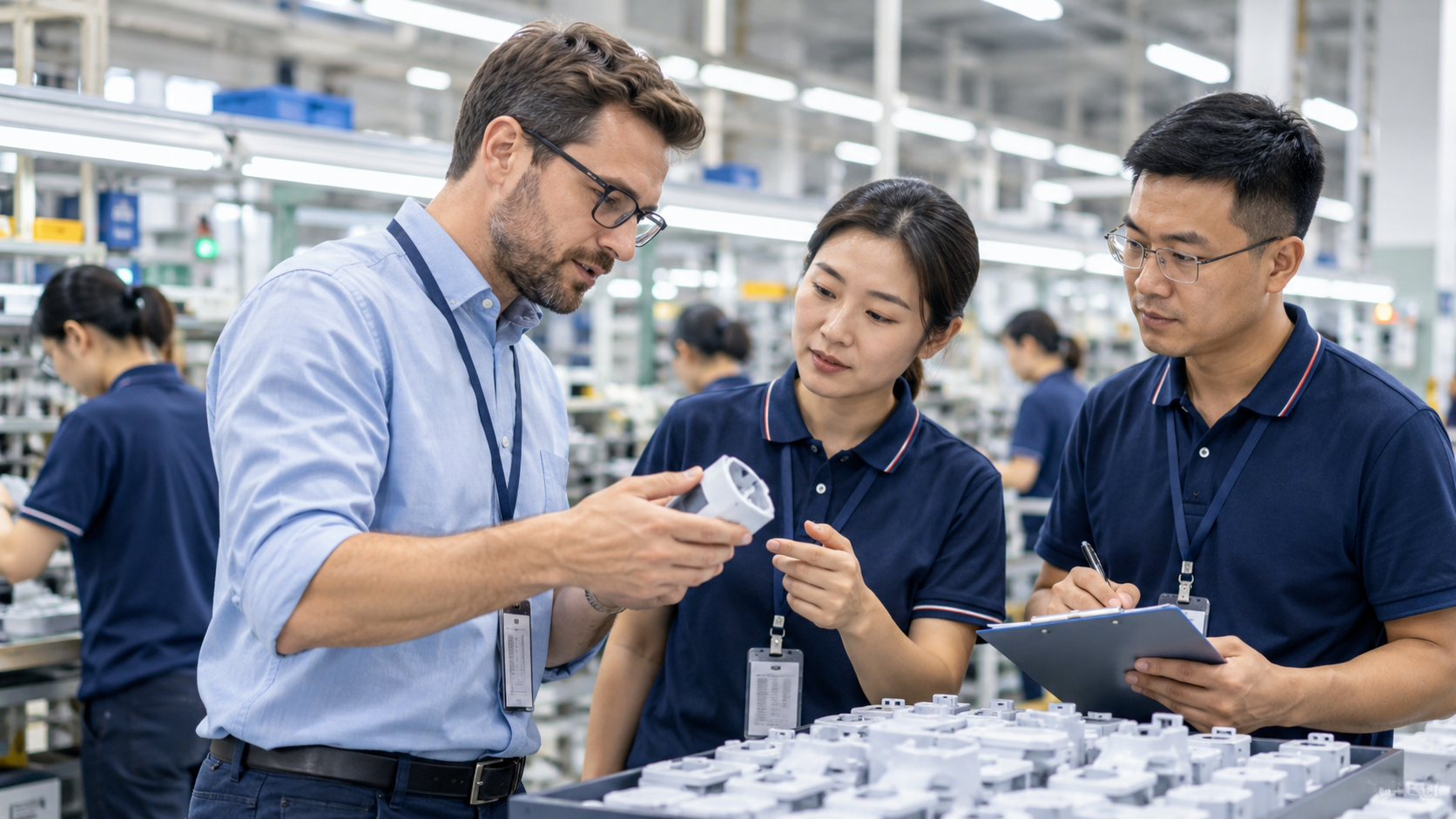
From Product Idea to Mass Production: How to Develop a Product in China
Turning a product idea into a finished product is rarely as simple as sending a drawing to a factory and waiting for a quotation.
For European companies looking to develop new products in China, finding a manufacturer is only the first step. The real work lies in translating an idea into clear technical requirements, developing a reliable prototype and making sure the final product can be manufactured consistently at scale.
This process involves several stages, and decisions made early on can have a direct impact on the final cost, quality and production timeline.
So, how can companies manage product development in China more effectively?
This article walks through the process step by step. For why companies develop products in China — beyond manufacturing alone — see China Product Development.
1. Start with a clear product brief
Before approaching manufacturers, it is important to define what you actually want to develop.
Some companies already have detailed technical drawings. Others may only have a reference product, a rough sketch or an initial concept.
Both situations are workable, but the information available will influence how the project needs to be managed.
A good product brief should cover the main requirements, including:
- Product dimensions, materials and components.
- Intended function and expected performance.
- Design, colours, finishes and other visual details.
- Target price and expected order quantities.
- Packaging requirements and destination market.
Not every detail needs to be finalised at the beginning. However, the more clearly the initial requirements are communicated, the easier it is for manufacturers to assess the project and identify potential technical difficulties.
One common mistake is to focus too much on the appearance of a product while overlooking practical considerations such as assembly, material availability, durability or production costs.
These points should be discussed before development goes too far.
2. Choose a manufacturer with the right technical capabilities
Not every factory that produces similar products is necessarily equipped to develop a new one.
Some manufacturers specialise in standard products and have limited experience with custom designs. Others have engineering teams, prototyping capabilities and experience adapting products to specific customer requirements.
The right choice depends on the complexity of the project.
Choosing the right partner starts with careful manufacturer sourcing and supplier selection.
When evaluating a potential manufacturer, buyers should look beyond the product catalogue and quotation. It is worth understanding:
- Whether the factory has relevant experience with similar products.
- What design and engineering support it can provide.
- Which production processes are available in-house.
- Whether tooling, moulds or special equipment will be required.
- How the factory manages product testing and quality requirements.
It is also important to understand who will be responsible for product development. A factory may have excellent production facilities but rely on external partners for design, engineering or mould manufacturing.
This does not automatically make it unsuitable, but responsibilities and communication channels should be clear from the beginning.
3. Develop a prototype before committing to production
Once the manufacturer has understood the requirements, the next step is usually to develop a prototype or sample.
This is where the initial concept starts becoming a physical product.
Depending on the project, the first sample may be produced using existing components, modified tooling or a completely new mould. The approach will depend on the product design, technical complexity and budget.
The first prototype should not be viewed simply as a final approval sample. It is an opportunity to identify problems and test whether the proposed design works in practice.
Does the product function as expected? Are the dimensions correct? Are the materials suitable? Is the finish acceptable? Can the different components be assembled properly?
A sample may look good but still have technical issues that only become apparent during testing or actual use.
It is therefore important to review the prototype against the original requirements and provide precise feedback to the manufacturer. factory audits and quality control can also support checks against the agreed requirements.
4. Manage revisions carefully
Product development rarely follows a perfectly straight line.
The first prototype may need adjustments. A component may not fit properly, a material may need to be changed, or the production cost may be higher than expected.
These revisions are a normal part of the process. The important thing is to manage them properly.
Every modification should be clearly documented and communicated to the factory. Updated drawings, measurements, material specifications and reference photos can help avoid confusion.
Another common mistake is approving a sample after making changes verbally, without updating the technical documentation.
This can create problems later if the factory continues working from an older version.
For projects involving several revisions, it is useful to keep a clear record of each sample, the changes made and the approval status.
Before moving forward, both parties should agree on the final version that will serve as the reference for mass production.
5. Make sure the product is ready for mass production
A successful prototype does not automatically mean that the product is ready for mass production.
A design may work well as a single sample but prove difficult or expensive to manufacture in larger quantities.
For example, certain components may require complicated assembly, materials may be difficult to source consistently, or production tolerances may be too demanding.
This is why manufacturers should review the product from a production perspective before the order is confirmed.
The discussion should cover production methods, material sourcing, tooling requirements, assembly procedures, expected lead times and quality standards.
For customised products, it is also important to clarify which specifications are fixed and which can be adjusted if production difficulties arise.
The objective is to make sure that the approved product can be reproduced consistently, not just that one sample looks right.
6. Follow the transition from sampling to production
Once the final sample is approved, the project enters another important stage: preparing for mass production.
This transition needs proper project management and coordination.
The factory should work from the approved specifications and sample, while any final changes must be confirmed before production begins.
Depending on the project, additional checks may be needed during the first production run to verify materials, dimensions, assembly and finishing.
Production follow-up also helps identify delays or technical issues early, when there is still time to find a solution.
For European buyers managing projects remotely, having someone on the ground in China can make a real difference. It allows communication with the factory to continue throughout development and production, rather than relying only on occasional updates.
How Eurasia Consultis supports product development in China
At Eurasia Consultis, we help European companies turn product ideas into manufacturing projects.
Depending on the client’s needs, our support can include:
- Manufacturer sourcing: Identifying factories with the technical capabilities and experience required for the project.
- OEM and ODM coordination: Working with manufacturers on customised designs and product development.
- Technical communication: Clarifying drawings, specifications, materials and production requirements between the customer and the factory.
- Sample development and follow-up: Coordinating prototypes, collecting feedback and tracking revisions.
- Production monitoring and quality control: Following the transition to mass production and checking that the agreed requirements are respected.
We work as a link between European buyers and Chinese manufacturers, helping both sides understand the project and move forward with clear expectations.
A successful product starts long before mass production
Developing a product in China is not simply about finding a factory willing to manufacture it.
It requires the right technical partner, clear specifications, careful sample development and proper coordination at every stage.
The earlier potential problems are identified, the easier they are to address. And the better the development process is managed, the smoother the transition to mass production is likely to be.
A good product is not just one that works as a prototype. It is one that can be manufactured reliably, consistently and at the right cost.
If you have a product to develop in China, or you are preparing to move from prototype to series production, tell us about your project.